At DML, Dorris Helps Researchers Develop Strategies to Answer Their Questions
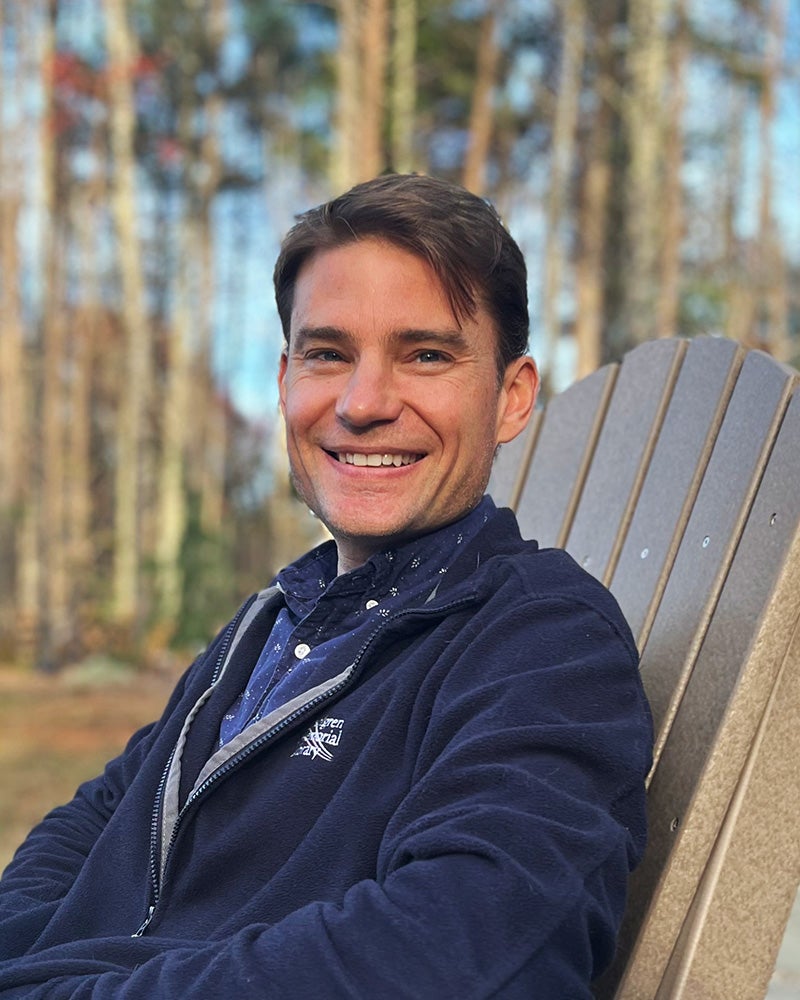
C. Scott Dorris
(August 28, 2026) — In the 18 years since C. Scott Dorris started working at Georgetown’s Dahlgren Memorial Library (DML), he has helped researchers develop strategies to answer questions, co-authored publications, led workshops on how to use biomedical databases and research tools, taught a course in evidence-based medicine and served on the institutional review board.
Having the opportunity to contribute to the Georgetown community in different ways has been challenging and engaging for Dorris, DML’s associate director of research services.
“It’s always nice to see that a librarian like me has made some sort of impact outside of what we normally would do, and I think Georgetown is a fairly unique institution that provides that for librarians,” he said. “It’s been a very enriching experience for me professionally and personally.”
Choosing Library Science as a Career
While earning his bachelor’s degree in anthropology at Penn State, Dorris worked as a barista in a cafe located in a chain bookstore. When the owner of the cafe announced their intention to relocate, Dorris and three colleagues pooled their money and became owners of the cafe.
After Dorris earned his degree, the chain of bookstores went bankrupt, so he started working for an internet-based used and rare bookstore. He also simultaneously worked at the Penn State Education and Behavioral Science Library and Penn State University Press. The three jobs combined his passion for books, information and helping people.
When the opportunity to live in Japan for a year came up, Dorris jumped at the offer, teaching English to children part-time. Knowing he wanted to pursue a career in library science when he returned, Dorris took the GRE in Japan and applied to the University of Pittsburgh, where he earned his Master of Library and Information Science (MLIS) degree.
Dorris was working as a librarian at Knox College in Galesburg, Illinois, when he learned about a job opening for a digital information services librarian at DML, the health and life sciences research library located on the Medical Center Campus.
“I thought this job and this institution spoke to me, so I applied and was offered the position,” he said. “But I went into it without fully being aware of the culture at Georgetown, at GUMC. And so becoming more aware of cura personalis and working with the faculty, staff and students, it’s become my longest held job and my most rewarding by far.”
A Field in Transition
When Dorris started at DML in 2008, the field of library science was adapting to the increasing availability of websites that empowered users to create and share content. “A lot of the social media and web 2.0 technologies were gaining in popularity,” he said. “In that specific role within the library, I helped promote our resources and services and managed the website, which was important at the time because all of our resources were available electronically.”
Dorris felt invigorated by the opportunity to learn about new technology and share his findings. “I love to be challenged,” he said. “I was coming from a liberal arts college, and while it was difficult at times, I really embraced the opportunity.”
Over time, DML has shifted to meet the needs of visitors by increasing the availability of digital resources, reducing the amount of books and printed materials in circulation, and creating more physical space for students to study individually and in groups. Similarly, Dorris strives to stay on top of the needs of DML’s patrons.
“Every day, I have new questions I need to help answer or support, questions from students, faculty, researchers,” he said. “And so it gives me the opportunity to continue with my lifelong learning while also aiding our patrons with their learning and research processes. And I really value that in this sort of work.”
From Questions to Answers
Dorris’ projects often start with a question posed by a researcher. “These sort of projects, like systematic reviews, are helped by an information professional, someone who can navigate databases and build search strategies in order to capture a comprehensive set of results so the researcher can synthesize and analyze the evidence to have a more poignant answer to a certain question,” he said.
“I also provide training to any individual who would like to work on those projects, whether they’re systematic reviews or just how to navigate a certain database or, in more contemporary times, how do I utilize artificial intelligence resources like Gemini responsibly and ethically,” Dorris added. “When we’re comparing databases like PubMed, they’re going to be totally different from Gemini or ChatGPT, for example, so information literacy is a large part of a librarian’s job.”
In addition to training individuals on how to use research tools, Dorris serves as co-director of a required course on evidence-based medicine in the M.S. in Integrative Medicine & Health Sciences Program and formerly served as a preclinical advisor for first- and second-year medical students.
“I get to know students in greater detail throughout their time at the medical school, and then I get to keep up with some of these students who are now attendings,” he said. “That’s a very rewarding experience, and these are things that I did not really plan for or expect by becoming a librarian.”
“Since I’ve been here, the team at DML and the broader medical campus have really supported the librarians in finding ways to work outside of the traditional librarian role, and I’ve been very fortunate to have those kinds of opportunities,” Dorris said.
Staying Connected
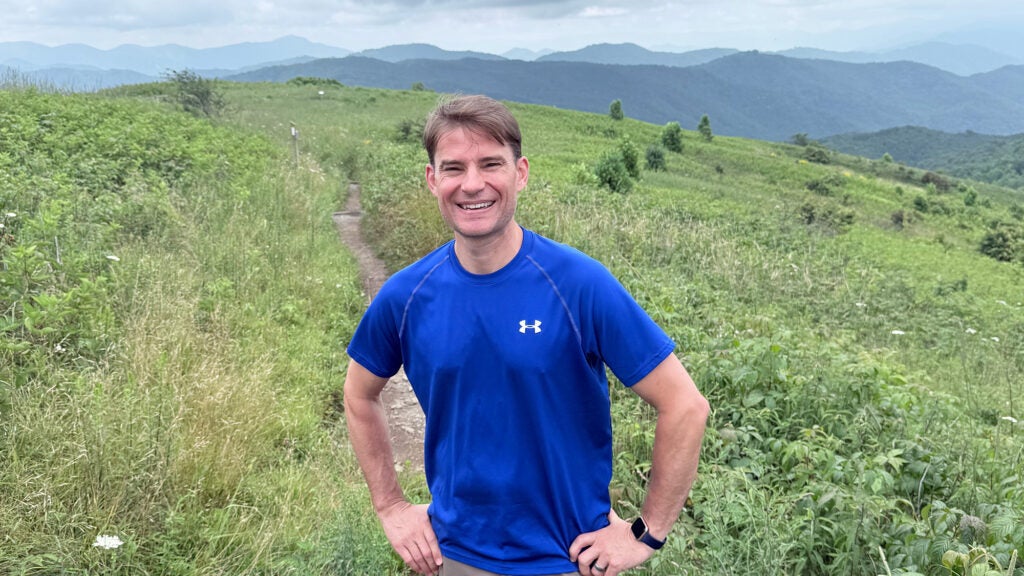
In his free time, Dorris enjoys hiking in the mountains of western North Carolina.
In 2017, Dorris’ wife was offered a job at Duke University, prompting Dorris to start teleworking from Durham, North Carolina. “Even though I’ve been a full-time teleworker since the end of 2017, I feel like I still maintain connections with folks,” he said. “That’s really special for me, and it keeps me going.”
In his free time, he enjoys hiking locally and in the mountains of western North Carolina, getting better at growing chili peppers in the backyard garden, and seeing live music at places ranging from the local performing arts center, music clubs and house shows.
“I find it very rewarding and restorative to go see performances, no matter where they are,” he said. “It gets you out of your comfort zone, going to someone’s house, being welcomed into someone’s house. We like this music, so we’re all going to be strangers together to bear witness to this artistic performance.”
Dorris also draws inspiration from those around him and likes to ask colleagues about their current interests. “Learning that information, however small it is, is something I find valuable,” he said. “Because then I’ll say, ‘What is this all about?’ Someone who recently left the IRB gave me a recommendation for romantic fantasy or romantic sci-fi novels, which is not something that I typically align myself with, but because they were so excited about it, I want to check it out now.”
Kat Zambon
GUMC Communications