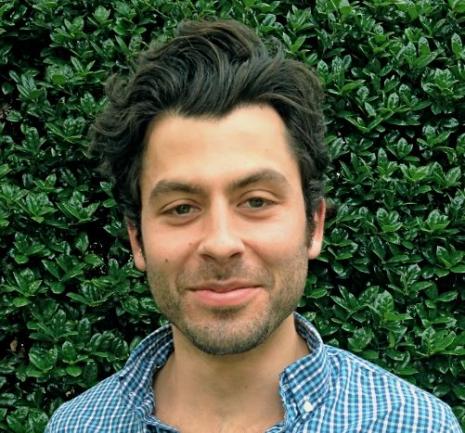
Neuroscience Student Elected to the Board of the American Tinnitus Association
JULY 24, 2015—When Ted Turesky came to Georgetown to work as a research assistant for Josef Rauschecker, PhD in July 2010, he had never heard of tinnitus, the auditory phenomenon characterized by the perception of a ringing in one’s ear without any actual source of sound. However, while recruiting participants for a study on tinnitus, he was struck by the distress of those suffering from the condition.
“People were calling trying to get involved in the study, and many of them seemed absolutely distraught,” Turesky said.
After doing some research, Turesky, now a PhD student in the Interdisciplinary Program in Neuroscience (IPN), was surprised to find that no Washington-based support group had been established yet. So he reached out to the American Tinnitus Association (ATA) , a national nonprofit that works to improve access to tinnitus management tools and funds advanced research.
With the help of ATA, Turesky started a tinnitus support group in the fall of 2010. The meetings, which take place quarterly at Georgetown, include guest speakers ranging from tinnitus researchers to cognitive behavioral therapists and mindfulness experts.
“As of right now, there is not much that doctors can do for the sound,” said Turesky. “But the sound triggers an emotional response, which then makes the sound worse, and before you know it, the sound is all you can focus on. So training yourself not to focus on the sound has been very helpful for people with tinnitus.”
Many researchers and doctors believe that tinnitus is caused by brain reorganization following damage to the inner ear, which causes the ringing or buzzing sounds that trouble patients. There is no cure for tinnitus, although many people have learned to manage the disorder through sounds, pharmacological or cognitive behavior therapy.
In January, Turesky asked Carol Bauer, MD, professor and chair of the division of otolaryngology at Southern Illinois University to be a guest speaker for the support group. Bauer had published a paper outlining best clinical practices for doctors who treat tinnitus, and Turesky felt that support group attendees would benefit from her knowledge.
“When I went to go speak at the support group, I thought I was going to meet an older guy with really bad tinnitus,” said Bauer, “That’s who I thought Ted Turesky was. To my surprise Ted is this young PhD student who was just really interested in tinnitus and facilitating the community dialogue on how to deal with tinnitus.”
It was Bauer who nominated Turesky to the board of the ATA.
“It was a great experience to see how well a self-help group can be run by a motivated, interested, empathetic person like Ted. And I was so impressed by him that I asked if he would be willing to serve on the board of the American Tinnitus Association.”
Turesky was elected to the 15-person board and his three-year term began on July 1, 2015. His primary role is to act as a support group liaison.
“The board is composed of finance professionals, audiologists, and tinnitus researchers, whose varying perspectives have generated a broad range of ideas,” said Turesky, “I’ve already learned a great deal. My hope is that my role will help strengthen the connection between the local support groups and the national organization, so that each tinnitus sufferer feels that they are a part of a larger community.”
Leigh Ann Renzulli
GUMC Communications
- Tagged
- neuroscience
- tinnitus